Packaging for construction materials has to protect the product, preserve identification, support safe handling, and fit the shipment and receiving plan. A solution that works at the factory may fail during stacking, consolidation, storage, or jobsite delivery. Buyers should define the product’s vulnerabilities, handling equipment, environmental exposure, carton or bundle configuration, labels, and destination requirements, then verify the packed product against those decisions before dispatch.
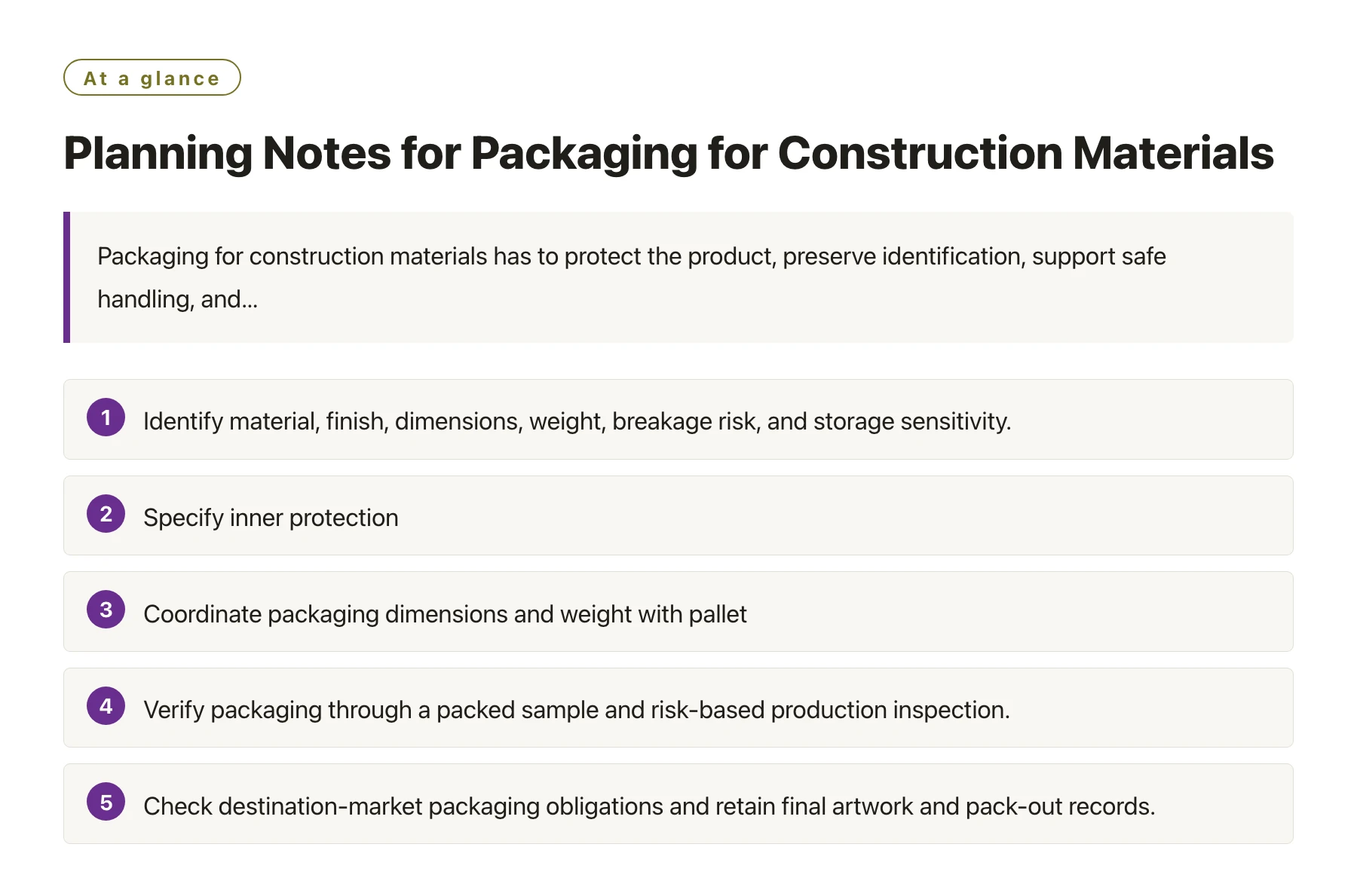
Key takeawaysIdentify material, finish, dimensions, weight, breakage risk, and storage sensitivity. · Specify inner protection, bundle or carton design, marks, unit counts, and handling limits. · Coordinate packaging dimensions and weight with pallet, container, warehouse, and site constraints. · Verify packaging through a packed sample and risk-based production inspection. · Check destination-market packaging obligations and retain final artwork and pack-out records.
The packaging brief should follow the material from production through receiving and installation, not stop at the factory gate.
Map the product risks and route
Start with product characteristics: fragile edges, surface finishes, moisture sensitivity, corrosion risk, dimensional stability, weight, shape, sharp points, and whether the item can be safely lifted by hand. A tile, sanitary fixture, lighting component, hardware kit, sheet material, and long profile each need different protection and handling. Do not assume one packaging style covers an entire construction category.
Map the expected route from factory packing to warehouse, consolidation point, port, transport, customs, destination warehouse, jobsite, and installation. Note transfer points, stacking, outdoor exposure, extended storage, and the equipment available at each location. Ask the warehouse or site manager about pallet size, unloading access, fork pockets, crane needs, door width, and delivery booking rules.
Buyers using building materials wholesale sourcing can provide suppliers with actual route and receiving constraints early. A packaging specification based only on the supplier’s standard export carton may omit local delivery, site storage, or phased installation needs.
Choose protection for the material
Describe what must not happen: chipped corners, scratched finishes, cracked surfaces, moisture ingress, mixed components, deformation, contamination, or loss of small parts. Identify contact surfaces and vulnerable edges. Specify separators, cushioning, caps, sleeves, bags, barriers, desiccants, or rigid supports only where the product and transport conditions justify them. Ask the supplier to explain how protective layers are removed without damaging the finish or creating a site hazard.
For bundles or long profiles, define support points, restraint, orientation, maximum bundle size, and protection at ends. For sheet products, specify how faces and edges are separated and how the load is restrained. For brittle items, ask how individual pieces are immobilized and whether movement can be detected during handling. Product engineering or logistics specialists should review any performance test needed for high-risk cargo.
Do not rely on a package supplier’s generic claim that packaging is “export standard.” Request drawings or photos of the actual pack-out, materials and thicknesses, closure method, and loading arrangement. If products are nested, stacked, or shipped assembled, document the arrangement and any maximum stack or lifting conditions verified for that configuration.
Make pack-out and identity unambiguous
Specify units per carton, pieces per bundle, accessories per kit, and how variants are separated. Identify model, size, finish, lot, purchase-order reference, and destination on labels where required. A clear code system helps receiving teams match goods to drawings and delivery schedules. If project phases or rooms require different products, state whether cartons must be grouped and marked by phase.
List packaging components: inner wrap, edge guards, separators, carton, strap, pallet, protective cover, hardware bag, instruction sheet, and labels. Identify which materials or artwork are buyer-supplied and who approves revisions. Ask for a packed sample when fit, protection, or installation sequence matters. Confirm that any barcode, QR code, or project label remains visible after pallet wrapping.
Construction materials may be sold by piece, box, square meter, length, weight, or set. State both the commercial unit and the physical pack quantity, including partial cartons or mixed packs. Ensure quotation, purchase order, packing list, carton mark, and receiving plan use compatible measures so quantity reconciliation does not depend on guesswork.
Coordinate dimensions, weight, and handling
Request outer dimensions, gross and net weight, center of gravity where relevant, stackability, lifting points, and pallet configuration. Compare these with warehouse racks, container loading, forklifts, cranes, truck limits, and jobsite access. Oversized or heavy packages may require special equipment or delivery appointments. Confirm who arranges and pays for those services and whether the quote includes them.
Set clear handling symbols and instructions only when their meaning is appropriate and the supply chain can follow them. Where the product must stay upright, dry, or protected from direct contact, make the instruction visible on multiple sides if needed. Align package orientation with loading and unloading methods. If safe handling requires specific lifting gear, include that information in the delivery and site coordination documents.
Check whether palletization complies with the destination’s import and warehouse requirements, including any treatment or marking rules that may apply. The importer and freight provider should confirm the current destination rules; do not copy a mark from another shipment. Maintain a record of the pallet type, dimensions, and gross weight to support booking and receiving.
Plan for moisture, storage, and site conditions
Ask the product owner to define storage limits and whether packaging can remain intact outdoors or in an unconditioned warehouse. Moisture barriers, ventilation, and desiccants serve different purposes and can be ineffective if applied without considering the material and storage duration. Identify who monitors conditions and how the packaging should be inspected after a long hold or a reported water event.
Consider the time between delivery and installation. If the material may be stored for weeks, label any shelf-life or handling restriction and give the receiving team a safe way to inspect the condition without losing product identity. Keep different batches or finishes separated if mixing would create visible variation. Confirm how open cartons are resealed and how partial quantities are tracked.
For products with adhesives, coatings, sealants, or other date-sensitive components, ask the manufacturer or qualified technical owner how temperature and storage affect use. Avoid using a general packaging assumption as a substitute for product-specific instructions. Put any handling limits in the purchase and shipment documents, and train the relevant receiver on how to report an excursion.
Review waste and market requirements
Packaging requirements and waste rules vary by destination and change over time. The European Commission’s packaging information describes EU policy and the Packaging and Packaging Waste Regulation; importers placing products on that market should confirm current requirements for the relevant product, packaging layer, and role with their compliance owner. [1] A supplier’s statement that packaging is recyclable or compliant should be supported by the specific material and market evidence requested.
Ask what packaging materials are used and whether buyer requirements constrain certain substances, formats, or recycled content. Consider practical reuse, disassembly, and disposal at the receiving location. Do not make environmental claims from a material label alone; ensure the evidence and claim are reviewed by the responsible team and that local collection systems are considered.
If a customer, project, or jurisdiction requires particular symbols, languages, declarations, or reporting, identify who supplies and approves them. Include the final artwork revision in the controlled product file. Keep the regulatory review distinct from physical protection tests so a package can be assessed for both functions.
Test the packed product and inspect production
Review one or more packed samples using the intended materials, closure, pallet, and labeling. Check that the product fits, protective layers remain in place, parts are complete, packages can be identified, and the intended handling method is feasible. For transit-risk testing, define the method and acceptance criteria with a qualified packaging or logistics professional before production. A sample test supports conclusions only for its tested configuration and conditions.
Include packaging checks in the production or pre-shipment inspection plan. Depending on the order, verify carton or bundle dimensions, gross weight, material, closures, labels, pack quantities, palletization, and visible damage. Select cartons or bundles using the agreed method and record what was opened, resealed, or not inspected. Keep the approved packed sample and packaging drawing available as references.
When an issue is found, identify affected product and packaging lots, not just the outer carton. Decide whether repacking, replacement, additional inspection, or shipment hold is needed. Record who approves the correction and how completion will be verified. A supplier should not substitute carton strength, separator, or label stock without review if it changes a requirement or tested arrangement.
Connect packaging to quotations and delivery
Ask suppliers to quote packaging in a comparable way: materials, pack quantities, carton or bundle count, pallet, marks, loading, and any custom tooling. Show one-time artwork or die charges separately from recurring unit costs. Request the dimensions and gross weight used for freight calculations. If a packaging alternative changes density or protection, show its effect on shipping and damage exposure.
Clarify who pays for loading, export handling, inland collection, consolidation, storage, unloading, and final delivery. State the delivery term and named place in the contract. Ensure the supplier and freight forwarder agree on package size, stackability, and handling before the booking. If goods ship in phases, align carton marks and packing lists with each release.
At dispatch, reconcile the approved package specification with the packing list, photographs, carton labels, and booking details. At receipt, check count, external condition, and visible moisture or impact evidence before discarding protective materials. Record damage with photographs and package identifiers so the cause and affected lot can be investigated.
Maintain a useful packaging record
Keep the product specification, packaging bill of materials, drawings, artwork, approved sample photos, test records, inspection results, and shipment dimensions together. Note the revision and supplier site. Store superseded files separately and require a documented review when product or packaging changes. This allows a later reviewer to know exactly which pack configuration was used for a particular order.
After delivery, review damaged goods, missing parts, storage issues, site handling, disposal, and schedule effects. Link each observation to the product, shipment, package type, route, and known conditions. Update future packaging requirements based on the evidence. Do not generalize from a single damaged carton without understanding its handling history or how many packages were affected.
Sources
Frequently asked questions
Should packaging be specified by the buyer or supplier?
The buyer should state protection, identification, handling, market, and receiving needs. The supplier can propose a pack design, which should be reviewed and approved against those needs.
Is export packaging suitable for jobsite delivery?
Not automatically. Check the full route, storage duration, handling equipment, delivery access, and project phasing in addition to factory and international transport needs.
What should be included in a packaging sample review?
Review product fit and protection, package materials and closure, labels, pack quantity, dimensions, handling method, and any agreed performance or storage checks.
Can packaging materials be changed after approval?
Require review when a change can affect protection, dimensions, handling, market obligations, waste claims, or freight assumptions, and retain the approved revision.