Borrowing Against Mined Coins Without Selling Them
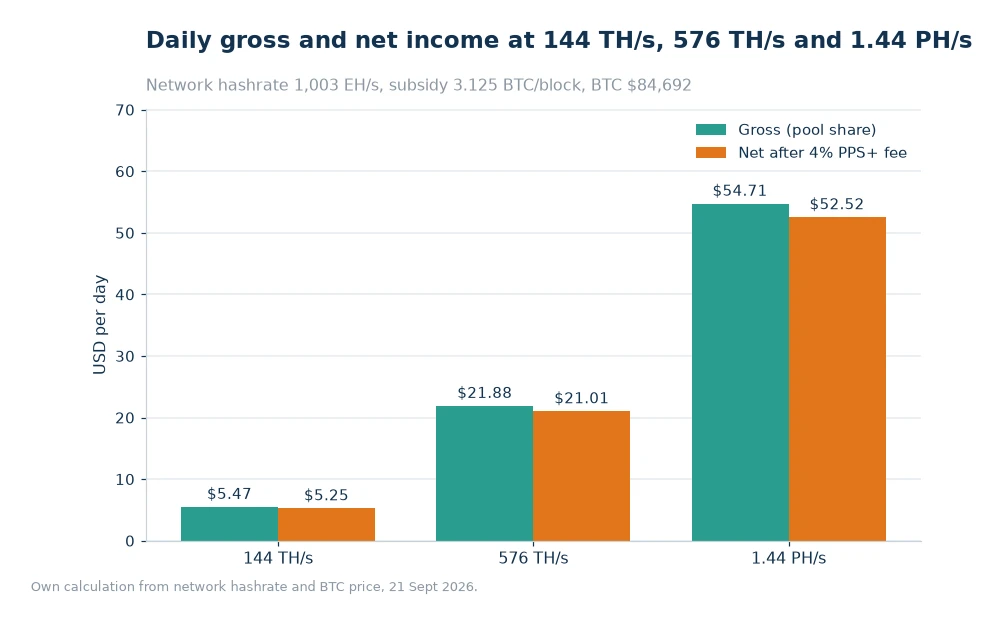
A 144 TH/s machine settles 6.46e-05 BTC a day, which is $5.47 gross and $5.25 after the listed charge, or $157.50 across a month. When a bill arrives before that month's coins have accumulated, selling part of the balance is one answer and pledging it is another. The difference is whether the position stays open while the obligation is met.

Key takeaways
- 144 TH/s settles $5.25 a day, and 1.44 PH/s settles $52.52 on the same basis.
- A Collateral-Pledged Loans position lets the coins stay in place while cash is borrowed against them.
- The cycle runs Add Collateral, Apply for Loan, Receive Loan, Repay Loan, Redeem Collateral — in that order.
- Borrowing adds a repayment obligation to a revenue stream that already moves with difficulty, so the schedule must fit the worst month, not the best.
Selling is not the only way to meet a bill
Mining has a timing problem that has nothing to do with profitability. Power is billed on a calendar, coins arrive hourly, and the gap between the two is usually small but occasionally awkward. A large repair, a quarterly demand charge or a tax payment can land in a week when the balance is thin, and the reflex is to sell whatever is there.
Selling resolves the timing problem by closing the position. If the plan was to hold the coins, that plan now has a hole in it, and rebuilding the position means buying back at whatever price prevails later. Pledging offers a different trade: the coins remain as collateral, the cash arrives, and the position is still there when the obligation is settled.
Nothing about that trade is free. A loan carries its own terms, the collateral is committed while the loan is outstanding, and the repayment has to come from somewhere. The point is that the choice is a choice, rather than an automatic sale whenever the bank balance dips.
The five steps, in order
The process is deliberately sequential. Add Collateral puts coins into the position. Apply for Loan sets the amount and terms against that collateral. Receive Loan delivers the funds. Repay Loan closes the obligation. Redeem Collateral releases the coins once repayment is confirmed.
An account on ViaBTC Mining Pool keeps the coins, the loan and the repayment history in the same place, which matters more than it sounds: a borrower who has to reconcile two systems is a borrower who misses a date. The cycle is visible at each stage, and the collateral does not move until the last step is complete.
The order matters because each step depends on the one before it. A miner cannot redeem collateral before the loan is repaid, and cannot apply for a loan before the collateral is in place. Skipping ahead produces a support conversation rather than a loan.
There is also a planning step outside the interface: decide in advance which coins are for pledging and which are for spending. Committing the entire balance leaves no buffer for an unexpected cost, and the buffer is what prevents a second loan before the first is finished.
What the loan has to beat
A borrowing decision is a comparison between two costs. The first is the cost of the loan itself, expressed in whatever terms the application shows. The second is the cost of the alternative, which is selling coins now and buying them back later, including the spread and the possibility that the buy-back price is higher.
There is a third cost that is easy to miss: flexibility. Collateral committed to a loan cannot be sold in a hurry without repaying first, so a miner who pledges everything has traded away the ability to respond to a sudden expense. Keeping part of the balance unpledged preserves that option, and the option has value even though it does not appear on any statement.
A schedule that only fits a good month is not a schedule but a hope.
The revenue side needs the same honesty. A repayment schedule built on the current daily credit assumes difficulty stays where it is and the machines keep running. Both assumptions have failed before for other operators, which is why a schedule with slack is worth more than one that only works in a good month.
The collateral cycle at a glance
The table groups the five steps into four practical stages, because applying and adding collateral are usually done in one sitting. The right-hand column is the thing to confirm before moving on.
| Stage | Action | Confirm before continuing |
|---|---|---|
| 1 | Add Collateral, then Apply for Loan | The amount, term and repayment dates shown in the application |
| 2 | Receive Loan | The funds have arrived and match the approved amount |
| 3 | Repay Loan | Each payment has cleared and the outstanding balance is falling |
| 4 | Redeem Collateral | Repayment is complete and the coins are back in the balance |
Stage three is where most of the risk sits, not because repayment is difficult but because it competes with everything else for the same coins. A miner who repays from the daily credit is effectively running two obligations at once: the power bill and the loan. At 144 TH/s the settled credit is $5.25 a day, so a repayment schedule that assumes most of that is available leaves very little for the electricity that produced it.
Worked example
Take the 144 TH/s machine, work out what it produces and what it costs to run, and see what is actually available for a repayment.
- Daily rate for one TH/s: 450 ÷ 1,003,000,000 = 0.00000044865 BTC.
- 144 TH/s: 144 × 0.00000044865 = 0.00006461 BTC, written 6.46e-05.
- Gross: 0.00006460 × 84,692 = $5.47.
- Listed charge: 5.47 × 0.04 = $0.22, leaving $5.25.
- Power at 20 J/TH: 2,880 W × 24 = 69.12 kWh; × 0.06 = $4.15 a day.
- Free cash flow before other costs: 5.25 − 4.15 = $1.10 a day, or $33.08 over 30 days.
- Monthly settled credit: 5.25 × 30 = $157.50; monthly power: $124.42; remainder $33.08.
- A repayment schedule that needs more than about $33 a month from this single machine would have to be funded from somewhere else, which is the number to know before applying rather than after.
Frequently asked questions
Do I lose the coins when I pledge them?
No, they are held as collateral rather than sold, which is the point of the arrangement; they are released through Redeem Collateral once the loan is fully repaid, and until then they cannot be spent or sold.
Can I repay early?
The application sets out the terms and any conditions attached to early repayment; read them before committing, because the value of pledging depends on how quickly the position can be closed if the plan changes.
How much can one 144 TH/s machine support?
That depends on the collateral value and the terms offered, not on hashrate directly; the machine itself settles about $157.50 a month before power, and its free cash flow after a $0.06 tariff is roughly $33 a month.
Model the repayment before you apply
Write the monthly settled credit on one line, the power bill on the next, and the proposed repayment on the third. If the third line is larger than the difference between the first two, the schedule depends on something other than this machine, and that something should be identified before the loan is drawn. The Collateral-Pledged Loans page sets out the five-step cycle, and the Profit Calculator gives the daily credit at current difficulty so the first line is not a guess. Borrowing against coins is a way to manage timing, not a way to create margin that was not there.
Sources: ViaBTC loan, calculator and pricing pages[1]. Chain snapshot 21 Sept 2026: 1,003 EH/s, 132.76 T, 3.125 BTC every block, 144 blocks a day, $84,692 per BTC. Published 24 Oct 2026; no borrowing ratio or rate is assumed.